
The complete guide
Choosing Puppy Food For A Small Or Toy Breed, Without The Guesswork
The problem with buying puppy food for a tiny dog
Walk down the pet food aisle with a four kilo puppy at home and the whole thing feels backwards. The bags are enormous. The pictures are all of golden retrievers bounding through fields. The feeding chart starts at ten kilos of body weight, and your dog does not weigh ten kilos and may never weigh ten kilos.
Small and toy breed puppies eat small amounts. That sounds obvious, but it changes everything about how you buy food. A 15 kg bag that is great value for a labrador owner is a trap for someone with a chihuahua cross, because the food sits open for months. Kibble size matters more too, since a big chunky piece is harder work for a little jaw.
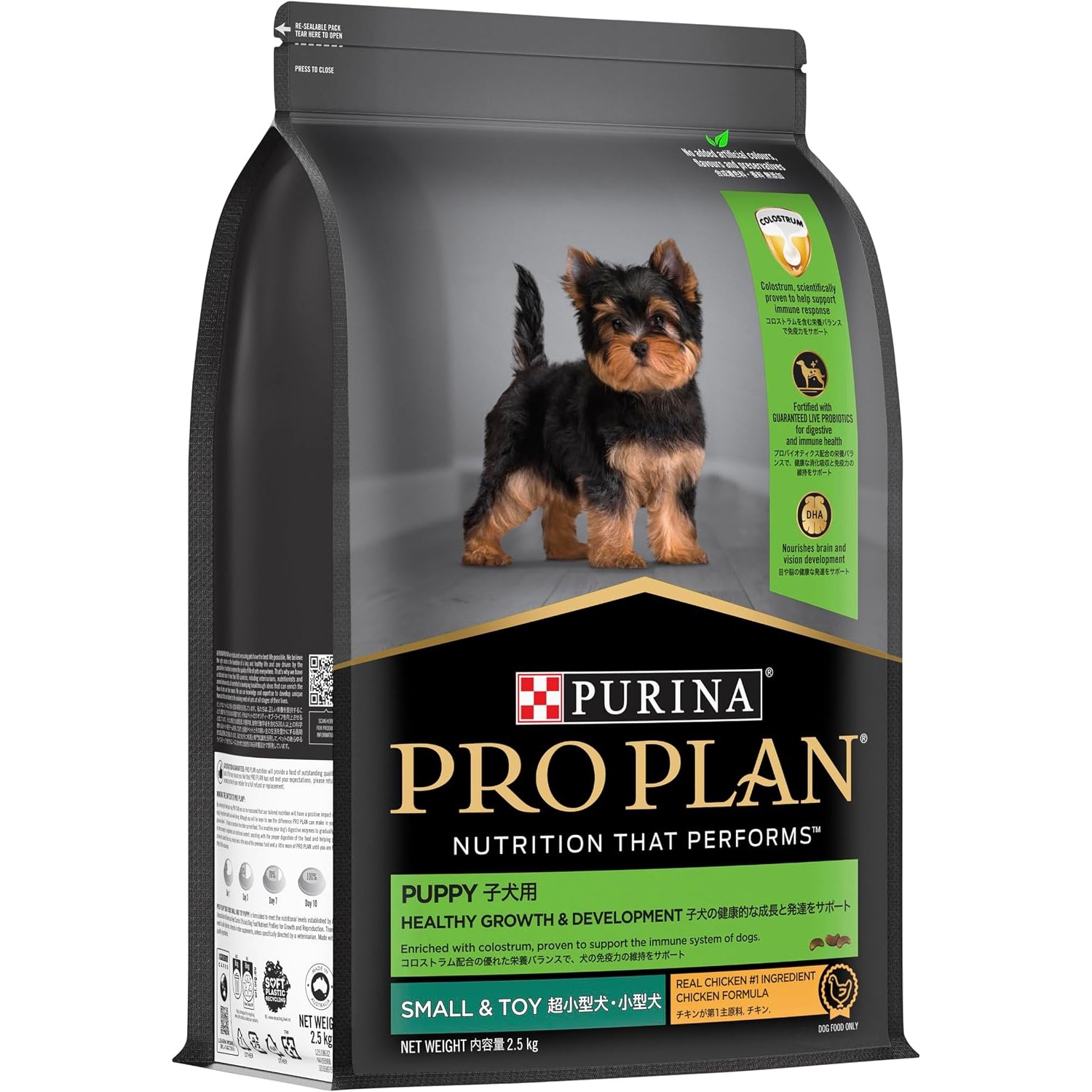
That is the gap this product sits in. Small & Toy Breed Chicken Puppy Food 2.5 kg is a dry kibble for the puppy life stage, made for small and toy breeds, with chicken as the protein on the pack. One bag, 2.5 kg, nothing complicated.
What is actually in the bag
We print the maker's ingredient list in full on this page rather than summarising it, because a summary is where useful detail goes to die. In order as printed: chicken meal and chicken (35%); animal fat; wheat gluten; brewers rice; whole grain wheat; oats; animal digest; barley; maize protein; a blend of minerals, vitamins and amino acids (including calcium, phosphorous, sodium, chloride, potassium, magnesium, zinc, iron, manganese, copper, selenium, iodine, aluminosilicate, vitamin A, B vitamins, vitamin C, vitamin D, vitamin E, choline, folic acid); beet pulp; fish meal and fish oil (a source of DHA); colostrum (0.1%) and natural antioxidants; and dried Bacillus coagulans fermentation product.
A few plain observations. Chicken leads the list and is quoted at 35 per cent. There are grains in there, so if you have decided on a grain free food, this one is not a match. There is fish in the recipe alongside the chicken. And if your puppy has a known problem with any specific ingredient, that list is the thing to read before you add to cart, not after the courier knocks.
We make no claims about what any of those ingredients do. Questions about your puppy's health belong with your vet, who has actually met your dog.
How much to feed, and how long a bag lasts
The feeding directions from the maker are brief, and the line that matters most is simple. Always have fresh, clean water available. Put the water bowl down and keep it topped up, every single day, regardless of what is in the food bowl.
For portions, use the feeding guide printed on the pack you receive. Puppy feeding amounts move with age and weight, which is why a page like this cannot give you a number. A nine week old toy breed and a five month old small breed are two very different jobs.
People always want to know how long 2.5 kg lasts. The honest answer is that it depends on your puppy's daily portion. Work it out yourself in thirty seconds: take the grams per day from the pack's feeding guide, divide 2500 by that number, and you have your rough days per bag. Do the same sum again in a month, because the portion will have changed as your puppy grows.
While you are at it, divide the price by 2.5 to get your cost per kilo. That single number is the fairest way to compare bag sizes and competing foods, and it is how most people find the best value puppy food for their own situation rather than the one with the loudest packaging.
Why a 2.5 kg bag suits small dogs
Bigger bags look cheaper per kilo. For a small puppy they often are not, because of what happens between the first scoop and the last.
A 2.5 kg bag is light. You can lift it with one hand, pour without spilling, and store it on a normal pantry shelf. It gets finished while the food is still fresh, rather than sitting half full for two months. And if you are trying a food for the first time, a smaller bag is a far cheaper experiment than a sack you might end up giving away.
There is also the simple matter of space. Not everyone has a laundry the size of a car park. A 2.5 kg pack fits in a cupboard, a small bin or a plastic tub, which is why it is a sensible first bag for a new puppy home.
Storing dry food properly
Dry kibble is easy to store badly without noticing. Heat, sunlight and air are the three things to keep away from it.
Keep the bag sealed between meals. Rolling the top down tight and clipping it works fine. If you prefer a container, the best puppy food storage container is one with a proper gasket seal that actually fits your bag size, and plenty of owners simply drop the whole bag inside the bin rather than tipping the kibble loose. That way you keep the printed feeding guide, the ingredient list and the date on the pack where you can find them.
Pick a cool, dry cupboard away from the oven and away from a sunny window. Use a dry scoop. Wash the food bowl daily, and wash the water bowl too. Check the date before you open a new bag.
If you also feed wet food, that is a different job. An opened tin or pouch goes in the fridge, covered, and gets used within a day or two. Never leave wet food sitting in the bowl in warm weather.
Changing foods without drama
The most common mistake with a new bag is swapping everything overnight. Puppies cope better with a slow change.
A week is the usual approach. Start with roughly three quarters old food and one quarter new. After a couple of days, go to half and half. Then a quarter old and three quarters new, then all new. Keep the old bag until you have finished the change so you can slow down if you need to.
Watch your puppy during the swap and keep meals on a routine. If anything worries you at any point, pause the change and ring your vet. That is the best way to switch puppy food in a sentence: slowly, with the old bag still on hand.
Who this suits, and who it does not
This is a good fit if you have a small or toy breed puppy, you want a dry food with chicken as the named protein, and you would rather buy a bag you can finish than a sack you have to ration.
It is not the right pick if you need a grain free recipe, if your puppy reacts to any of the ingredients listed above, if you are feeding a large breed puppy, or if you are feeding an adult or senior dog. In those cases, a different food is the sensible call, and your vet can point you at the right category.
Delivery and returns, in plain words
Orders are dispatched within 2 working days. After that, allow up to 7 working days with a tracked courier. Delivery is Australia only. Shipping is free on orders of $99 or more, and a flat $12 below that.
Change of mind returns are accepted for 14 days from delivery, as long as the pack is unopened and still in its original sealed packaging, with return postage paid by you. If something turns up faulty, damaged or not as described, that is covered under the Australian Consumer Law and we will put it right. There is no separate warranty on a food product, and there does not need to be.
The short version
Small & Toy Breed Chicken Puppy Food 2.5 kg is a dry kibble for puppies of small and toy breeds, with chicken meal and chicken at 35 per cent heading the printed ingredient list, sold as one 2.5 kg bag.
Read the ingredient list against anything your puppy reacts to. Use the feeding guide printed on the pack for portions. Keep fresh, clean water down at all times. Store the bag sealed, cool and dry. Change foods over about a week rather than in one go. And for anything to do with your puppy's health, ask your vet.