
The complete guide
Buying a 15 kg Bag of Adult Dry Dog Food, the Practical Guide
The problem with running out of dog food
Dog food is one of those shopping items that only becomes urgent when it is gone. You open the cupboard, see the bottom of the bag, and realise tomorrow's breakfast is a problem. Then you buy whatever small pack is nearest, which costs more per kilo, and the cycle repeats.
A 15 kg bag of dry kibble breaks that pattern. It is a big enough quantity that most households are not thinking about it again for weeks, and it usually works out cheaper per kilo than the smaller packs that line supermarket shelves. The trade-off is storage. Fifteen kilos takes up real space and needs to stay cool, dry and sealed. If you have a spot for it, the maths tends to work in your favour.
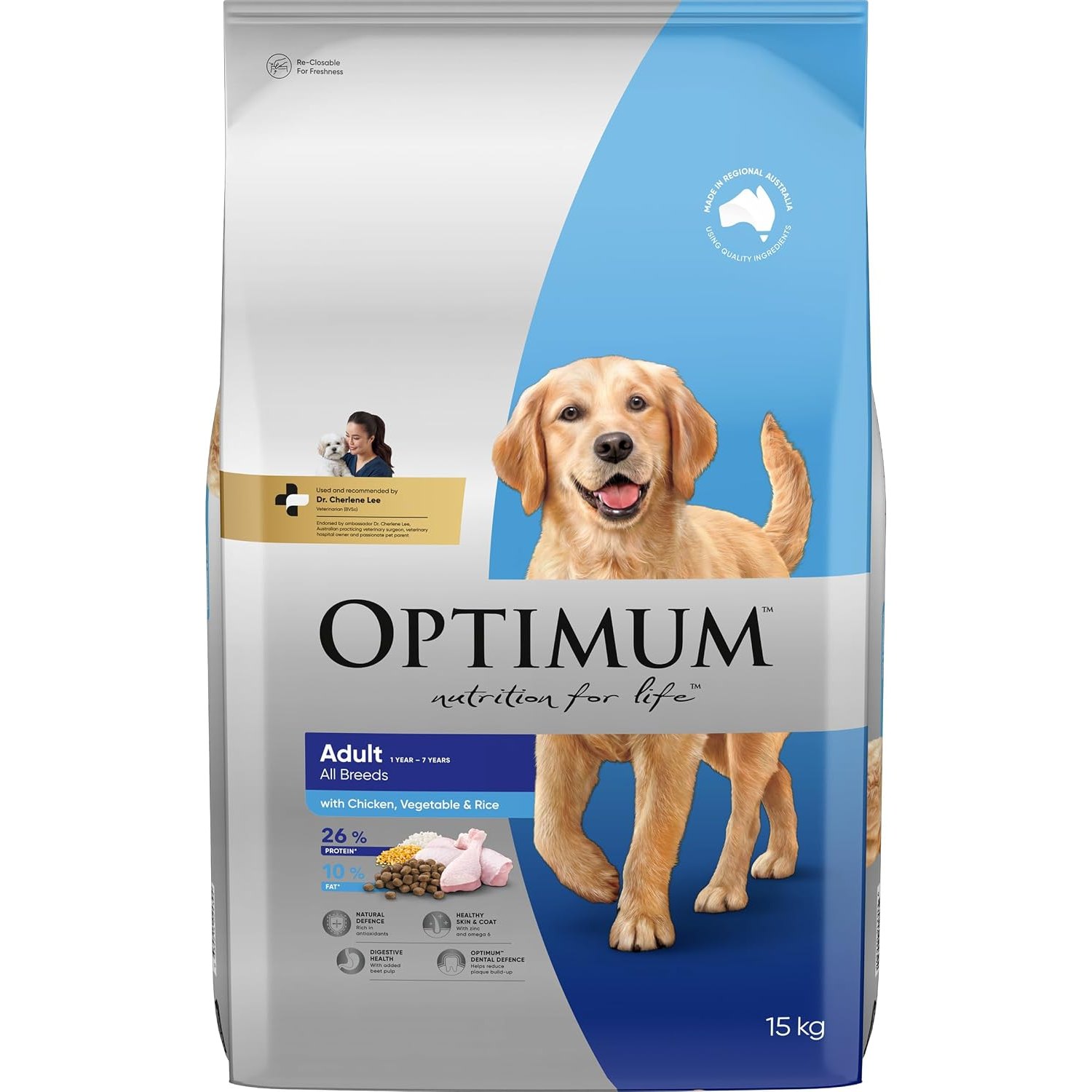
This guide walks through what Chicken, Vegetables & Rice Adult Dry Dog Food 15 kg actually is, who the pack size suits, how to work out portions and costs, and the practical habits that keep a big bag in good condition until the last scoop.
What this product is
The basics are short. It is a dry kibble, the life stage is adult, the breed size is all breed sizes, the flavour is chicken with vegetables and rice, and it comes in one 15 kg bag. That is the whole product in a sentence.
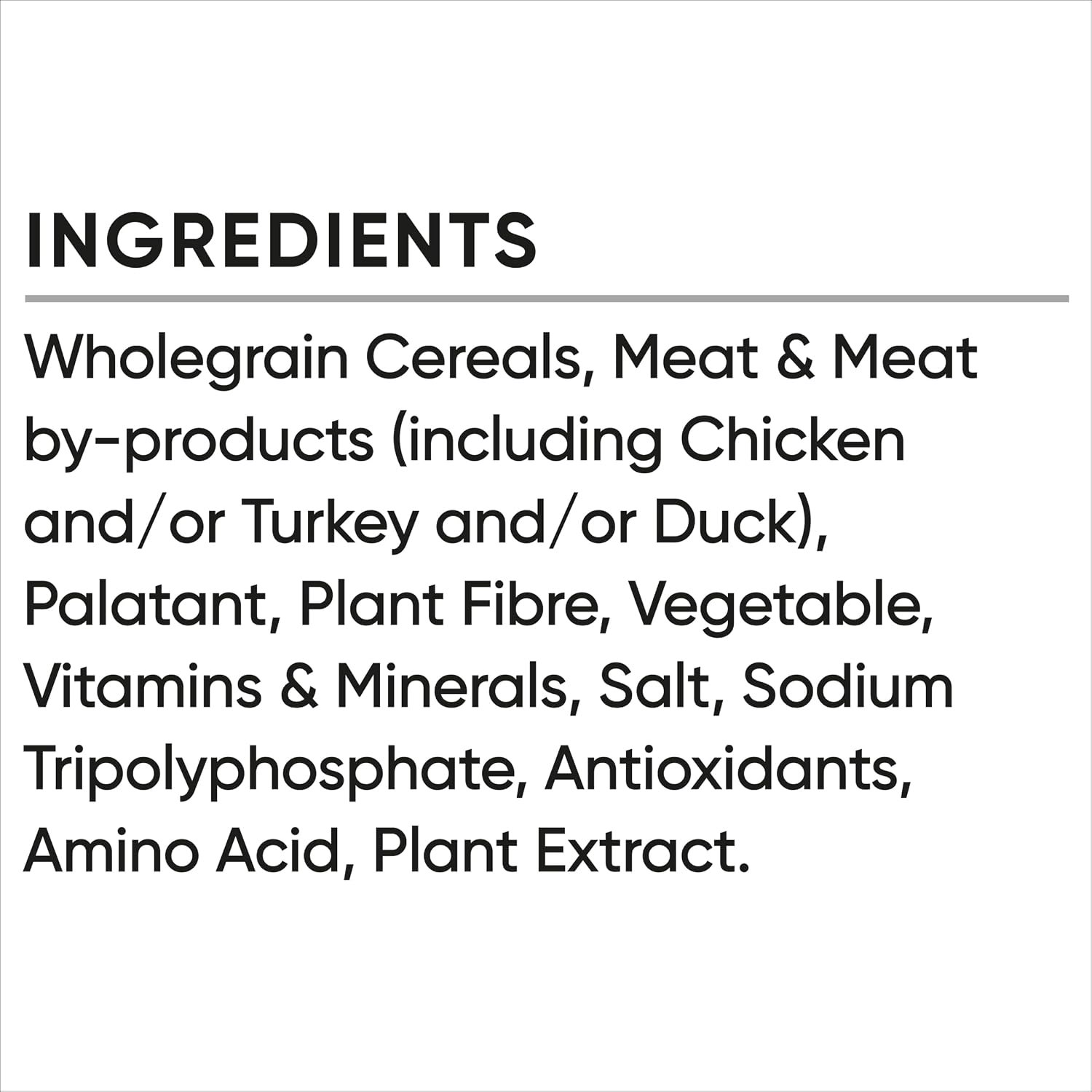
The ingredient list, exactly as the maker prints it, reads: poultry and poultry by-products; sorghum and/or rice and/or wheat; barley and/or corn; chicken digest; cereal protein; beet pulp; vegetables; salt; vegetable oil; minerals (potassium chloride, zinc sulphate, ferrous sulphate, copper sulphate, potassium iodide and selenium); sodium tripolyphosphate; vitamins (A, B1, B2, B3, B5, B6, B9, B12, C, D, E and choline) and antioxidants.
That list is worth reading properly rather than skimming. If your dog has a known intolerance to a particular grain or protein, this is where you check it. The "and/or" wording on the grains means the exact cereal can vary, which matters if you are avoiding one specifically. When in doubt, your vet is the right person to ask, not a product page.
How dry kibble fits into a daily routine
Dry food earns its place through convenience. It pours, it measures with scales or a cup, it sits happily in a sealed container at room temperature, and a bowl left half-finished for an hour is not a hygiene problem the way wet food can be. For anyone feeding on a schedule around work hours, that matters.
The flip side is water. A dog on dry food needs fresh water available all the time. Keep the water bowl full, rinse it when you refill it, and put it somewhere the dog passes often rather than tucked in a corner.
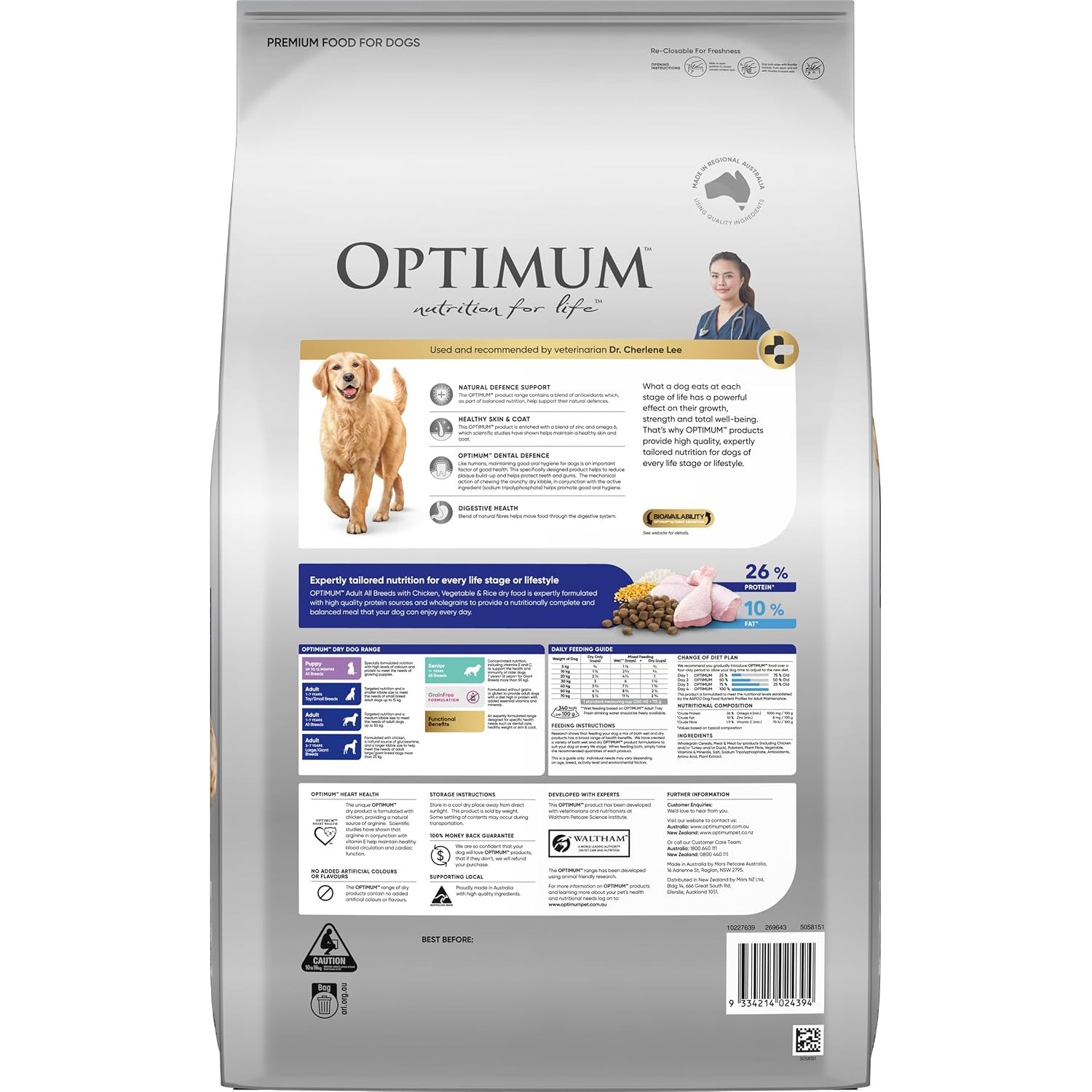
Some owners feed a mix of dry and wet. The maker's directions cover this directly: when you feed both, halve the recommended quantity of each product. That is a sensible starting point rather than a precise rule, and like all feeding amounts it is a guide only.
Working out portions
Every bag of dry food carries a feeding guide, and that guide is tied to the dog's weight. Find your dog's weight band, read off the daily amount, and that is your starting point.
Then adjust. The maker notes that individual needs vary depending on age, breed, activity level and environmental factors. A working farm dog in winter and a flat-dwelling dog who gets two short walks a day are not eating the same amount even if they weigh the same. Start at the printed figure, keep it steady for a couple of weeks, and watch how your dog goes. Changes should be small and gradual.
For accuracy, kitchen scales beat a scoop. Kibble pieces vary in density and a scoop that is "about right" can drift by a surprising margin over a month. Weigh it once, mark the level on your scoop, and you get speed and accuracy together.
Who the 15 kg size suits
The best 15kg dog food bag is the one you will actually get through before quality starts to drop. Roughly, the pack suits:
- A single large dog, where daily portions are big and the bag moves quickly
- A household with two or more dogs of any size
- Anyone who has settled on a food and is not planning to change
- People who would rather order every couple of months than every couple of weeks
It suits less well if you have one small dog with a modest daily portion and nowhere cool to store a big bag. In that case a smaller pack opened fresh may be the better call, even at a higher price per kilo.
Cost per kilo is easy to check. Divide the price by 15. Compare that to the price per kilo of whatever you are buying now, including any delivery you are paying. The gap is usually where bulk buying justifies itself.
Storing a big bag properly
Dry food keeps well, but only if you treat it well. Three things cause trouble: heat, moisture and pests.
Keep the bag somewhere cool and dry, out of direct sun. A pantry, a laundry cupboard or an indoor shelf is ideal. A hot garage in summer is the worst option. Once opened, roll the top down tightly and clip it, or tip the whole bag into a sealed container.
One tip worth following: if you decant into a container, put the empty bag in with the food rather than binning it. The bag carries the feeding guide and the batch details, and you will want both at some point.
Use dry hands or a dry scoop. Moisture introduced into the bag is what starts the problems. Wash food bowls regularly, the same as you would any other dish in the house.
Changing foods without drama
If your dog is currently eating something else, do not swap in one go. Spread the change over about a week. Day one or two, a small amount of the new kibble mixed into mostly the old. By mid-week, roughly half and half. By the end, fully across.
Going slowly makes the change less of a jolt, and it also gives you time to notice if the new food does not suit. If anything concerns you during a changeover, stop and talk to your vet.
Checking the list against your dog
Dogs with known sensitivities need a careful owner, and the ingredient list is your tool. Print it, screenshot it or save this page, and compare it line by line against whatever your vet has told you to avoid. The grains here are listed with "and/or" options, so if you need certainty about a specific cereal, that is a question for your vet rather than an assumption to make.
This is also true in reverse. If your dog has eaten chicken-based kibble happily for years, a chicken, vegetables and rice formulation is familiar territory, and the switch is likely to be uneventful.
Delivery and returns in plain terms
Orders are dispatched within 2 working days. After that, allow up to 7 working days by tracked courier. Delivery is Australia only. Delivery is free on orders of $99 or more, and a flat $12 under that figure.
Change of mind returns are accepted within 14 days of delivery, as long as the pack is unopened and still in its original sealed packaging, with return postage paid by the customer. That restriction is normal for food. If something arrives faulty, damaged or not as described, that is handled under the Australian Consumer Law and we will put it right. There is no separate warranty on a food product.
The short version
Chicken, Vegetables & Rice Adult Dry Dog Food 15 kg is a straightforward dry kibble for adult dogs of any breed size, sold in one large bag. Work out your dog's daily portion from the printed feeding guide, divide 15,000 by that number, and you will know roughly how long the bag lasts. Store it cool, dry and sealed. Switch over across about a week if you are coming from another food. Keep water available. Read the ingredient list against anything your dog needs to avoid, and take health questions to your vet.