
The complete guide
Buying a 20 kg Bag of Beef Dry Dog Food, A Practical Guide
The problem with running out of dog food
Anyone who has fed a dog for a few years knows the feeling. You tip the bag, a sad handful comes out, and dinner is an hour away. Small bags look cheap on the shelf, but they empty fast, and the reordering never stops. For a household with one hungry adult dog, that is mildly annoying. For a property with several working dogs, it is a proper nuisance.
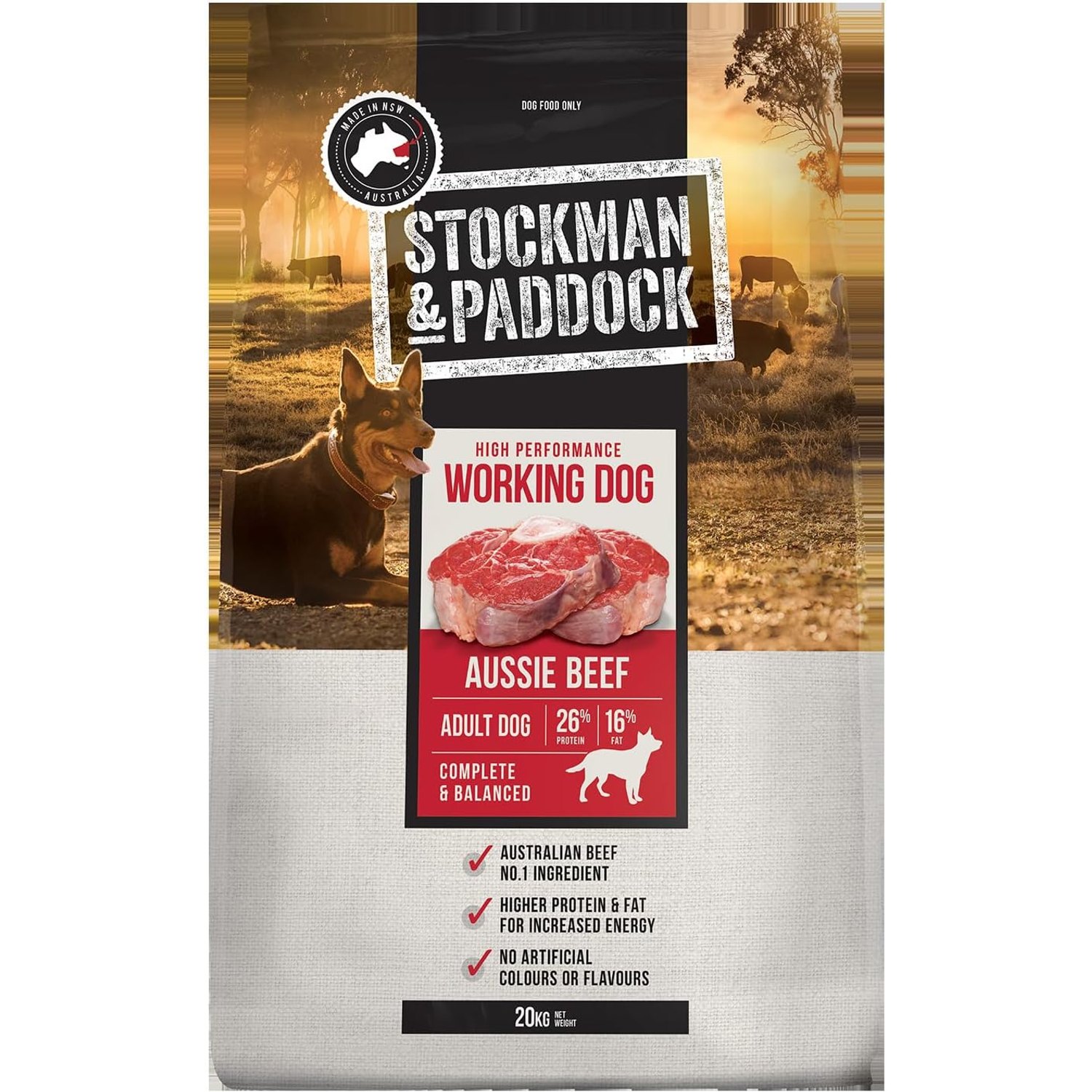
Beef Working Dog Dry Food 20 kg is aimed squarely at that problem. It arrives as one 20 kg sack of dry kibble, with beef as the named protein or flavour, listed for adult working dogs of all breed sizes. You buy once, you store it properly, and you stop thinking about it for a while.
What you are actually getting
Let us keep this simple and stick to what is on the pack.
The form is dry kibble. The life stage listed is adult working dogs. The breed size listed is all breed sizes. The protein or flavour is beef. The pack size is one 20 kg bag.
The ingredient list, exactly as the maker prints it, is Australian beef meal, Australian wheat, Australian wheat meal, Australian hydrolysed chicken protein, Australian beef fat, beet pulp, natural flavour, salt, potassium chloride, flaxseeds, dry chicory root, choline chloride, essential vitamins (A, D, E, B1, B6, niacin, riboflavin, folic acid, B12) and minerals (zinc, copper, manganese, iodine, selenium) and antioxidants.
Two things in that list are worth a second look before you order. The first is wheat, which appears twice, as wheat and as wheat meal. The second is hydrolysed chicken protein, which sits in there alongside the beef. If you have been steering clear of either for your dog, now is the moment to notice, not after a 20 kg bag lands on your doorstep.
For feeding amounts, the maker says to see the packaging for details. That printed guide is the figure to work from. We are not going to invent a number for you.
How dry kibble fits into a routine
Dry food is popular for a plain reason. It is easy to handle. You scoop it, you serve it, and you are done. There is no refrigeration, no decanting of half-used tins, and no race against the clock before it spoils.
That convenience shows up most in multi-dog households and on properties. If you are feeding three or four dogs twice a day, anything fiddly becomes a chore very quickly. Kibble lets you measure out portions with one scoop and get on with your morning.
The other practical benefit is portion control. Because kibble is consistent in size and density, a measured scoop tends to give a repeatable amount. Weigh out the daily figure from the feeding guide once, see how many scoops that is, and you have a reliable system you can hand to anyone else in the house.
Working out how long a bag lasts
This is the question everyone asks, and the honest answer is that it depends on the printed feeding guide and how many dogs you have.
The maths is easy though. A 20 kg bag holds 20,000 grams. Find the daily grams for your dog's weight and activity on the pack, then divide. If the guide puts your dog at 400 grams a day, that is 50 days from one bag. Two dogs at that rate takes it down to 25 days. Four dogs, a bit under a fortnight.
Do that calculation on day one and write the reorder date on your calendar. It beats discovering the problem at 6pm on a Sunday.
Working out whether it is good value
Cost per kilo is the only comparison that means anything across different bag sizes. Divide what you paid by 20 and you have it. Then do the same for any smaller bag you were considering and compare like with like.
Bulk buying usually wins on that number. But the saving only counts if you actually use the food while it is in good condition. A 20 kg bag that sits half-finished in a damp shed for six months is not value, it is waste. Match the pack size to how fast your household gets through it.
Who a 20 kg bag suits
It suits people feeding more than one adult dog. It suits single-dog households with a large dog that eats a solid daily portion. It suits anyone who would rather order four times a year than once a month, and who has a cupboard, a bin or a cool corner of the laundry to put it in.
It is less suited to small households with one small dog who eats modestly, simply because the bag may be open for a long stretch. And it is not the right pick if you have no dry, cool, sealed place to keep it.
Storing it properly
Dry food keeps well, but only if you treat it well. Heat, damp and sunlight are the three things to avoid.
Pick an indoor spot if you possibly can. Garages and sheds swing wildly in temperature, and concrete floors draw up moisture. An internal cupboard, a pantry or a laundry corner is far better.
Once open, either roll the bag top down and clip it firmly, or tip the kibble into a clean airtight bin. If you use a bin, keep the original bag with it. The ingredient list and the feeding guide are printed there, and you will want both. Use a clean, dry scoop, and never tip fresh kibble on top of old crumbs at the bottom of a bin. Empty it, wipe it out, then refill.
Changing your dog over to a new food
If your dog has been eating something else, do not swap it all at once. The standard approach is a gradual changeover across roughly a week.
Start with a small amount of the new kibble stirred through the usual food. Each day, nudge the proportion up a little and the old food down. By the end of the week you should be feeding the new food on its own. Plenty of owners stretch this to ten days or so, and there is no harm in going slowly.
Through the whole process, keep fresh water available at all times. Wash the bowl regularly, especially if you have added water to soften the kibble.
Reading the ingredient list for your dog
Every dog is different, and you know yours better than any product page does. The ingredient list on this pack is published in full above, which means you can check it properly before you buy rather than after.
Go through it line by line against anything your dog has reacted to in the past. If something gives you pause, or if your dog has an ongoing health issue of any kind, that is a conversation for your vet. We sell the food. We do not diagnose dogs, and we would not pretend to.
The short version
Beef Working Dog Dry Food 20 kg is one bulk bag of beef-based dry kibble, listed for adult working dogs across all breed sizes. The full ingredient list is printed by the maker and reproduced on this page. Feeding amounts come from the guide on the packaging.
Before you order, check two things. First, that nothing in the ingredient list is something your dog avoids. Second, that you have a cool, dry, sealed place to keep 20 kg of food. Get those sorted and the rest is straightforward.
Orders are dispatched within 2 working days, then arrive within up to 7 working days by tracked courier, Australia only. Delivery is free on orders of $99 or more, otherwise a flat $12. Change of mind returns are accepted within 14 days of delivery if the pack is unopened and in its original sealed packaging, with return postage paid by you. Anything faulty, damaged or wrongly described is put right under the Australian Consumer Law.