
The complete guide
Soft Chicken Treat Sticks, A Practical Buyer's Guide
The problem with the treat drawer
Most households end up with the same mess. Three half-finished bags of biscuits, one of them gone stale, a packet of something the dog refused twice, and a jar of crumbs at the bottom of the pantry. Meanwhile the thing you actually reach for every day is whatever is soft, quick and easy to tear.
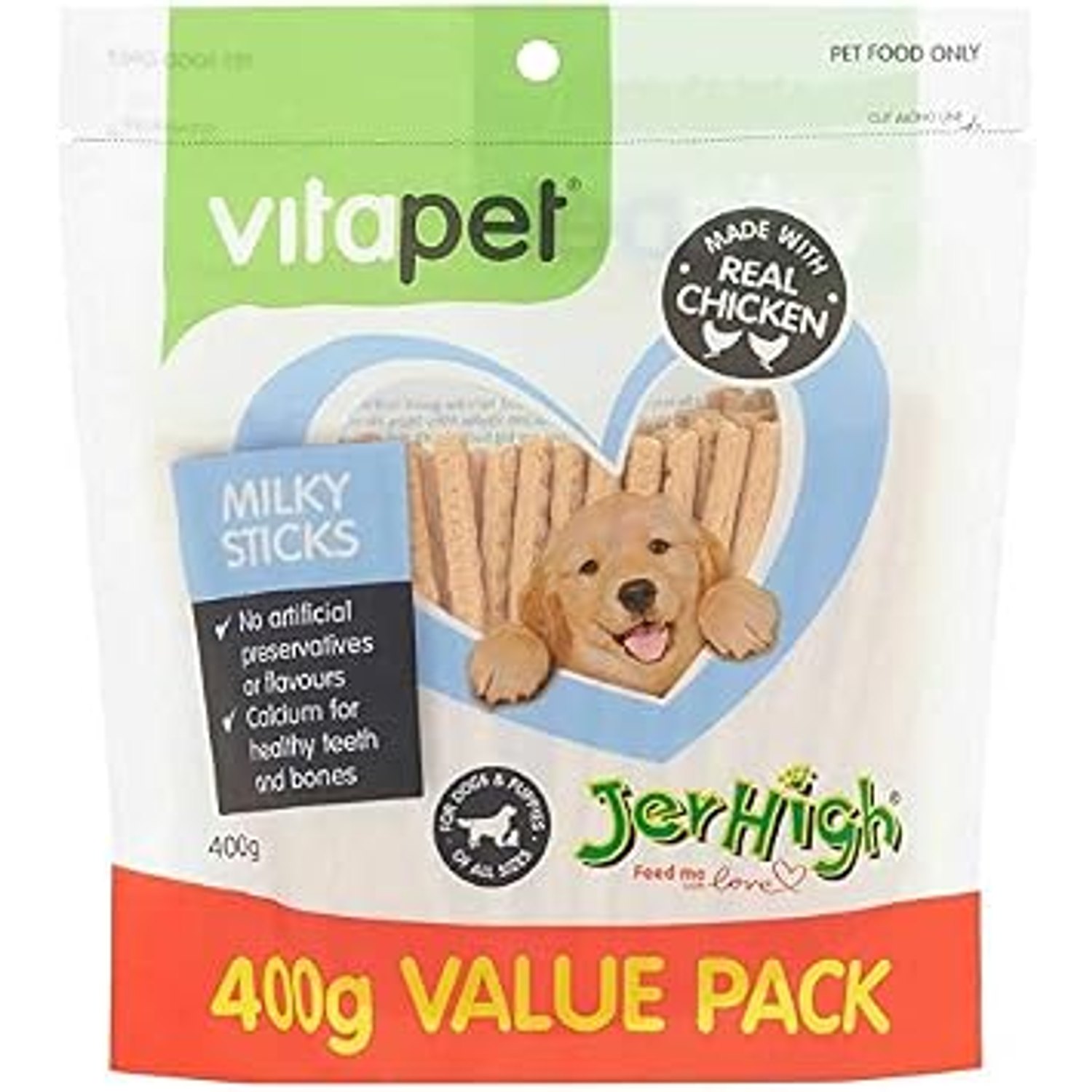
That is the gap soft chicken sticks fill. Milky Chicken Stick Dog Treats 400 g are made with chicken meat and skim milk powder, and they come as pliable sticks rather than hard baked biscuits. You can break one apart with your fingers in about a second, which matters far more in daily life than it sounds.
This guide walks through how the format works, who it suits, how to size a pack, how to store it, and how to be sensible about feeding amounts. No health claims, no hype, just the practical side.
What is actually in the bag
The ingredient list, exactly as printed by the maker, is chicken meat, water, salt, skim milk powder, vitamin C, sugar, glycerine, milk flavour and tapioca starch.
That is worth reading slowly if your dog has known sensitivities. Chicken and dairy are two of the things owners most often watch for, and both appear here. If either is on your dog's avoid list, this is not the pack for you, and that is fine. If you are not certain whether your dog reacts to something, your vet is the person to ask. Do not test it by trial and error on a training day.
For everyone else, the list is short and readable, which is genuinely useful. You can scan it in ten seconds and decide.
Why soft beats crunchy for training
Think about what happens during a training session. You ask for a sit, the dog sits, and you need to mark and reward inside about a second. A hard biscuit takes time to crunch. The dog looks away, chews, hunts for the bits that fell on the floor, and by the time attention comes back, the moment has gone.
A soft piece goes down fast. You get more repetitions in the same five minutes, and repetitions are what build the behaviour.
Soft also means you control the size. One stick can become four pieces for a medium dog, or eight small ones for a terrier. People searching for the best soft dog treats are usually chasing this exact property, whether they have put it into words or not. A 400 g bag that gets torn into small rewards goes a very long way compared to the same weight handed out whole.
There is a practical pocket benefit too. Soft sticks do not shatter into dust in a jacket pocket the way dry biscuits do. They can get a bit tacky in warm weather, so a small lidded tub inside your treat pouch is a good habit.
Who the pack suits
The product is listed for puppies and adult dogs, and for all breed sizes. In practice that means it works in most households, including ones with more than one dog.
For a puppy, think small. Tear a stick down and hand over a modest piece. Young dogs are learning fast and you will be rewarding often, so portion size is the lever you pull to keep the day's total reasonable.
For an adult small dog, a torn section is usually plenty. For a medium dog, maybe half a stick. For a large dog, a whole stick can be one reward. None of that changes what the treat is, only how much of it a dog gets at a time.
Older dogs often appreciate a softer texture, though if your dog has any health condition at all, that is a conversation for your vet rather than a product page.
Sizing the pack and working out value
One bag holds 400 g. That is a middle size, and middle sizes tend to be the sweet spot for most homes.
Buy too small and you reorder constantly. Buy a huge bulk pack and it sits open for months, slowly losing its appeal while you try to use it up. A 400 g bag generally gets finished while it is still in good shape, which is the real measure of value.
To compare prices properly, convert everything to cost per kilogram. Divide the pack price by 0.4 and you have the per-kilo figure. Do the same for any other pack you are considering, whatever its size, and suddenly the comparison is honest. A bigger bag is not automatically cheaper per kilo, and plenty of people are surprised by that the first time they check.
How long a bag lasts is not something anyone can tell you from a distance. It depends on your dog's size and how many treats you hand out, measured against the feeding guidelines printed on the packaging. Use those guidelines as your reference point, watch the bag for a fortnight, and you will know your own rate.
Storing them properly
Treat storage is simple and people still get it wrong.
Keep the bag cool, dry and out of direct sunlight. The cupboard above a kettle or next to the oven is the worst spot in the kitchen because of the heat and steam. A lower cupboard away from the stove is better.
Once opened, seal the bag tightly. If the closure is not great, tip the sticks into an airtight container instead. Soft treats are more sensitive to damp than dry biscuits, and a container also stops the smell drifting through the pantry.
Wash your hands after handling treats, the same as you would with any raw-adjacent food. And if anything in the bag goes unusually hard, sticky or smells off, throw it out. It is not worth the gamble over a few sticks.
Feeding sensibly day to day
Treats are an addition to the diet, not a replacement for it. The feeding guidelines on the packaging are your reference for how much to give, and they account for dog size.
On a heavy training day, it is reasonable to trim the evening meal slightly. On a quiet day, you may hardly open the bag at all. Neither is a problem as long as you are paying attention to the overall picture rather than treating the bag as unlimited.
Fresh water should be down at all times. That is true every day, but it is an especially easy thing to forget after a long session outside.
If you are switching your dog's main food, do it gradually over about a week, adding a little more of the new food each day. Keep treats steady through that period. Changing two things at once makes it impossible to work out what caused any difference, and you end up guessing.
A few honest limits
Pack dimensions, shipping weight and country of origin are not given on the pack details we hold for this item, so we are not going to guess at them. The number of sticks per bag is not specified either, only the 400 g total, since stick size varies.
We also make no claims about teeth, digestion, coat, joints or anything else. They are treats made with chicken and skim milk powder. If you have a health question about your dog, your vet has the context we do not.
Delivery and returns in plain terms
Orders are dispatched within 2 working days. After that, allow up to 7 working days by tracked courier. Delivery is within Australia only. Shipping is free on orders of $99 or more, and a flat $12 below that.
For change of mind, you have 14 days from delivery to return an unopened pack in its original sealed packaging, with return postage paid by you. If something arrives faulty, damaged or not as described, we sort it out under the Australian Consumer Law. There is no separate warranty on a food product, and there should not be.
The short version
Milky Chicken Stick Dog Treats 400 g are soft chewy sticks made with chicken and skim milk powder, suited to puppies and adult dogs of every breed size. The soft format tears easily, which makes it practical for training and for carrying in a pouch.
Read the ingredient list against your dog's known sensitivities. Follow the feeding guidelines on the packaging. Store the bag cool and dry, seal it after opening, and keep fresh water available.
Work out the cost per kilo by dividing by 0.4 if you want to compare it against other packs. And for anything health related, ask your vet.