
The complete guide
Beef Tendon Dog Chews, A Practical Buyer's Guide
The problem with most of the chew aisle
Walk down the dog treat section of any shop and the labels start to blur. Half the bags carry a long ingredient list you would need a chemistry degree to parse, and the other half carry a short list buried under a lot of adjectives. You are usually standing there with a trolley and a dog at home who has started chewing the skirting board, and you just want something firm, something that lasts longer than ten seconds, and something you can actually understand.
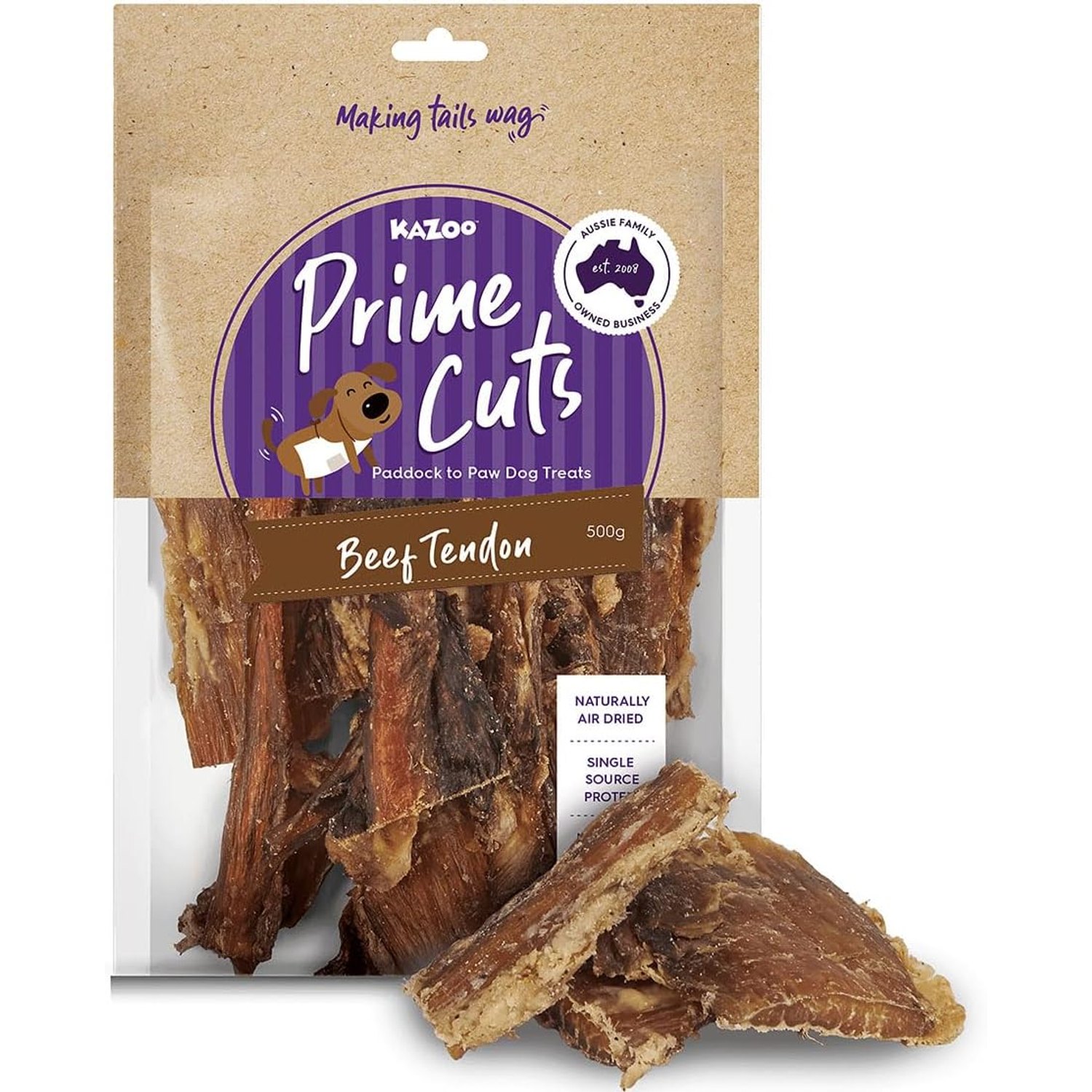
That is the gap Beef Tendon Dog Chews 500 g sits in. The form is dried tendon chews. The ingredient list as printed by the maker reads 100% Australian Beef. The pack holds 500 g. It is listed for all life stages and all breed sizes. You can read the whole thing in about four seconds, and there is a certain relief in that.
What a tendon chew actually is
Tendon is the tough, fibrous tissue that joins muscle to bone. It is naturally dense and stringy, which is exactly why it ends up as a chew. When it is dried, it becomes firm enough that a dog has to commit to it rather than inhale it.
That difference between a treat and a chew matters more than people expect. A treat is a transaction. You ask, the dog does, the dog gets a reward, and the whole thing is over in a second. A chew is an occupation. It gives a dog a job for a stretch of time, and a dog with a job is a dog who is not doing something you would rather it did not do.
How long one piece lasts is genuinely unpredictable until you have watched your own dog have a go. A small dog with a delicate jaw might work at a piece for a long while. A large dog who treats everything as a demolition project might get through the same piece in a few minutes. Neither is wrong. You just need the first session to calibrate your expectations.
Who the 500 g pack suits
Five hundred grams is a middle-of-the-road size, and that is deliberate. It is big enough that you are not reordering every fortnight, and small enough that it will not sit around going stale at the back of a cupboard if your dog only gets a chew now and then.
It works well for a single dog household where a chew is a two or three times a week thing. It works just as well for a two dog household where chew time is a shared ritual. Because the pack is listed for all breed sizes, you do not have to buy separate bags for the terrier and the labrador. You portion to the dog, not to the bag.
If you are shopping for the best bulk dog chew bag for a household of four dogs, 500 g may be more of a trial size than a stock-up. Buy one, see how fast you move through it, then decide. That is a far better method than guessing up front.
How to compare value properly
Price per bag is the wrong number to compare. Price per kilo is the right one.
Divide the pack price by 0.5 and you have the per kilogram figure for a 500 g bag. Do the same sum for every other bag you are considering, including bags of different weights, and suddenly they all line up on the same scale. A bag that looks cheaper on the shelf is often the more expensive one once the maths is done.
The other half of value is how long a piece actually lasts with your particular dog. A chew that occupies a dog for twenty minutes is worth considerably more than one that is gone in two, even if both cost the same per kilo. This is the part no product page can tell you, which is why the first bag is partly a test.
Reading the label against your own dog
The ingredient list as printed by the maker reads 100% Australian Beef. That is useful information if your dog is known to react to certain proteins, because it tells you plainly what is and is not in play. A dog that does not get on with beef is not a candidate for this one, and that is a two second decision rather than a research project.
For anything less clear-cut, your vet is the right person to ask. We do not make health, nutrition or veterinary claims about this product, and anyone who tells you a chew will fix a specific health problem is going further than the facts support. What we can tell you is the form, the ingredient list, the pack size and the feeding directions. Everything beyond that is between you and your vet.
The feeding directions, and why they are short
The directions printed by the maker come down to three lines. Always provide clean, fresh drinking water. Always supervise your dog whilst feeding treats and chews. Pet food only.
The water one is easy to overlook and genuinely worth doing. A dog working on a dried chew will usually want a drink afterwards.
The supervision one is the important one. Chews shrink as they get worked on, and there comes a point where a piece has gone from a chew to a swallowable lump. You want to be in the room to notice that moment and take it away. This is not a hand it over and leave the house product. Treat chew time as a short, supervised activity, and you remove most of the risk.
The pet food line is exactly what it sounds like. This is not for people, and it should be stored away from food that is.
Storage, so the bag lasts as long as it should
Dried chews keep well, but only if you treat them properly. The enemies are heat, damp and sunlight.
Keep the bag somewhere cool, dry and dark. A pantry shelf is fine. The top of the fridge next to a sunny window is not. Once the bag is open, the single best thing you can do is reseal it firmly or tip the whole lot into an airtight container. An open bag on the bench lets moisture in and lets the product go soft.
Put the container somewhere a determined dog cannot reach. Dogs are famously good at solving the problem of a cupboard they know contains chews.
Introducing them sensibly
If your dog has not had a chew like this before, start small. Give a portion of a piece rather than the whole thing, and watch how the session goes. If everything is fine, build up over about a week.
This slow approach is good practice with any new food or treat. It gives you a chance to notice if something does not agree with your dog before you have handed over a large quantity. If anything seems off at any point, stop and ring your vet.
The same logic applies to how you fit chews around meals. A chew is extra, not free. If your dog is getting a chew most days, that should be factored into the overall picture rather than simply added on top. Your vet can give you guidance that fits your dog's size and routine.
Making chew time useful
A few owners get more out of a chew by giving it a purpose. Hand one over when guests arrive and the dog needs to settle. Use one when you need a quiet half hour to take a call. Give one on a designated mat so the dog learns that mat means chew, which makes clean-up predictable and gives you a cue you can use later.
For a dog who gets anxious when the routine changes, something to chew can be a useful part of the settling process. You are not treating anything, you are simply giving the dog something familiar to do. That is a reasonable thing to expect from a chew, and it is about as far as the claim should go.
Delivery and getting it wrong
Orders are dispatched within 2 working days, then arrive within up to 7 working days by tracked courier. Delivery is Australia only. Shipping is free on orders of $99 or more, and a flat $12 below that.
For change of mind, you have 14 days from delivery to send back an unopened pack in its original sealed packaging, with return postage at your cost. Opened food cannot come back for change of mind, which is another reason to start with one bag rather than three. If anything arrives faulty, damaged or not as described, your rights under the Australian Consumer Law apply and we will put it right.
The short version
Beef Tendon Dog Chews 500 g is a dried tendon chew in a 500 g bag, with an ingredient list printed as 100% Australian Beef, listed for all life stages and all breed sizes. Compare it on price per kilo rather than price per bag. Store it cool, dry and sealed. Give the first piece while you are watching, keep water nearby, and let your dog's own chewing style tell you how much and how often. Anything health related goes to your vet, not to a label.